

This is an article I wrote for our church newsletter this past week:
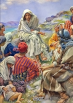
The Sermon on the Mount by Harold Copping (Public Domain from https://freechristimages.com/bible-stories/sermon-on-the-mount.html)
The Gospel for Feb. 1, 2026 is Matthew 5:1-12, Matthew chapters 5-7 are called “the Sermon on the Mount”: Our reading today contains the portion often titled “The Beatitudes”. What is a ‘beatitude’? Unfortunately, in this case, it may be a good example of our English Bible Translations including “helpful” headings, that are less than helpful. Why? Well, we have a lot of Believers that look at the Beatitudes as a list of ethical principles to strive after, or pursue. Our English speaking mind processes “BE-attitudes” — turning them into ethical principles to which we must “measure-up” OR “BE”. This, plus our understanding of the meaning of some of the other English words in this passage, leads us to believe we see a “spiritual to-do list”.
Ponder this: The Devil is active in this world, inserting partial truth, with the same goal as ever: get us to focus on ‘us’ – ‘we’ need to be on the throne – place ‘me’ in the center of the universe instead of the Father, Son, and Spirit. By viewing the Beatitudes as a moral checklist for ‘us’, we have fallen into the trap of self-condemnation: the one whispered by Satan = ‘You are so worthless that you even fail at embracing Jesus.’ Leading us to say things like,“I’ve tried to be pure in heart but fall short of the mark.” Viewing the Beatitudes as an ‘impossible’ list, effectively treats them as “Law”, not “Gospel”.
In reality, Jesus is saying, “Of course you missed the mark. You always will if you depend upon your own strength. WE – the Father, Son, and Spirit – know you well, and our plan has always known your true ‘human nature’ – OUR nature is grace, mercy, and love”
The English heading “Beatitudes” originates from the Latin heading, which means “happy or fortunate”. Historical theology does not see the “Beatitudes” as ‘moral checklist’, but more like a summary of the blessings God promises even to ‘failed’ people. Many English translations start the Beatitudes with “Blessed are …”. The Greek, “makarios” is what is translated into English as “Blessed are …”. The Greek “Makarios”, as used by the Hebrew author, conveys a state of being under the approving favor of God, a joy that springs from relationship with Him rather than from circumstances.
Jesus is teaching about the “Happy, fortunate, ‘God provided’ state of being favored by God, because of WHO God IS”. These teachings are not prescriptive things we must ‘do’ or ‘keep’ or ‘abide by’. Rather, they describe who the blessed are and what they will receive. It is all about God’s promises.
With the above in mind, let us peal back the onion on the “poor in spirit” in the Matthew 5:3 —
Paraphrasing, in light of what we now know, we have something like, ‘Extremely happy and fortunate, by God’s desire (Makarios), are those who know they are destitute of spirit.’ The Beatitude simply describes the way we are. We have no spiritual resources on our own. There’s nothing we can do to earn salvation. We’re born into the debt of sin, and we only go deeper into debt as we live. All people are poor in spirit, it is our nature. So, what is this ‘kingdom of heaven’ — well, the place of the ruling presence of God, but not just a place; the ruling activity of the King is included in the Greek. This kingdom includes everything Christ did, and still does, to bring us to eternal life with Him. Believers, who acknowledge their natural spiritual wretchedness, are given assurance, by Jesus that they are ‘in Him’: a part of God’s loving plan for salvation from before time began.
Back to the statement in the first paragraph about “… our understanding of the meaning of some of the other English words in this passage”: Consider “Blessed are the meek…” where the understanding of that word has evolved with time. Modern English speakers have an image of “timid, weak, obedient, passive, overly submissive or compliant” The original meaning was more like the original Greek, ‘praus’. ‘Praus (adjective) ’ or ‘Praotes (noun)’ are more than “meekness or meek” ‘Praus’ does not mean ‘weakness’ but rather refers to demonstrating power without undue harshness. In the world of Aristotle, ‘praotes’ was happy medium between two extremes, ‘excessive anger’ and ‘excessive lack of anger’. So historical Greek context is “Blessed is the man who is always angry at the right level at the right time, and never angry at the wrong time or at the wrong level.“
However, much time passed from Aristotle’s days and “other” understandings existed by New Testament times: Greeks contrasted “praotes” (meek), with “hupselokardia” (lofty-heartedness). The “praotes” concept includes true humility which banishes all pride. The the word, “praus”, has a second standard Greek usage referring to an animal which has been domesticated, which has been trained to obey the word of command, or which has learned to answer to the reins. It is the word for an animal which has learned to accept control. So, ponder this … Think of those giant Budweiser Clydesdale Horses: If a Clydesdale decided it was not going to play friendly with people, not obey commands, ignore the reins and bit. Well, there really would be nothing a handler could do to force the animal to comply, the horse is simply too large and too strong; one would simply have to let the horse go free, or harm the horse with something that compensates for how much more powerful the horse is than a man. Meekness is a term of power under conscious control — so:
‘Extremely happy and fortunate, by God’s desire (Makarios), are those who’s every instinct, every impulse, every passion and every power possessed is willingly under the control of the Spirit of God (Praotes)”
To get an image of Jesus demonstrating ‘praotes’ look at the Cleansing of the Temple (Mark 11:15-19; Luke 19:45-48; John 2:12-25): Jesus was righteously angry: turned over tables, and used a whip. Jesus could have called down the hosts of heaven or fire to destroy them all, but it was not the right time nor the right execution of righteous anger to do so.
Consider ‘praotes’ form the Hebrew authors’ perspective: In the Beatitudes, Jesus is quoting from Psalm 37, a very Hebrew perspective. It is logical to conclude that Jesus’ intent by the quote is to convey the concept from a Hebrew perspective that considers a person can humble oneself before the true God, and expect God’s hand upon his life. From the original “hearer’s” perspective, it is not so much the blessing of the man who is self-controlled, for such complete self-control is beyond human capacity. Rather, it is the blessing of the man who is completely God-controlled – for it is only in service to God that we find our perfect freedom, and in doing His will that we find perfect peace, which leaves no room for pride.
Consider Luke 22:42-44 (ESV): 42 saying, “Father, if you are willing, remove this cup from me. Nevertheless, not my will, but yours, be done.” 43 And there appeared to him an angel from heaven, strengthening him. 44 And being in agony he prayed more earnestly; and his sweat became like great drops of blood falling down to the ground. – Humankind would soon murder Jesus, on a cross. Jesus had the power to prevent what He knew was coming. Jesus could have turned His profound despair at this moment into a response of righteous anger, and simply spoke the world into nothingness. Rather, with glorious meekness, strengthened by the an angel, Jesus physically and mentally, as truly man, suffered in agony – the blood vessels in his sweat glands rupturing under the strain. Jesus then suffered great agony on the cross, died, descended into hell, and arose in victory!
— “Extremely happy and fortunate, by God’s desire (Makarios), are those who’s every instinct, every impulse, every passion and every power possessed is willingly under the control of the Spirit of God (Praotes)”
There is an older Pondering of mine, from 2022, related to this subject that provides some additional insights to part of the current Pondering at Meekness & the Most Dangerous Person in the Room